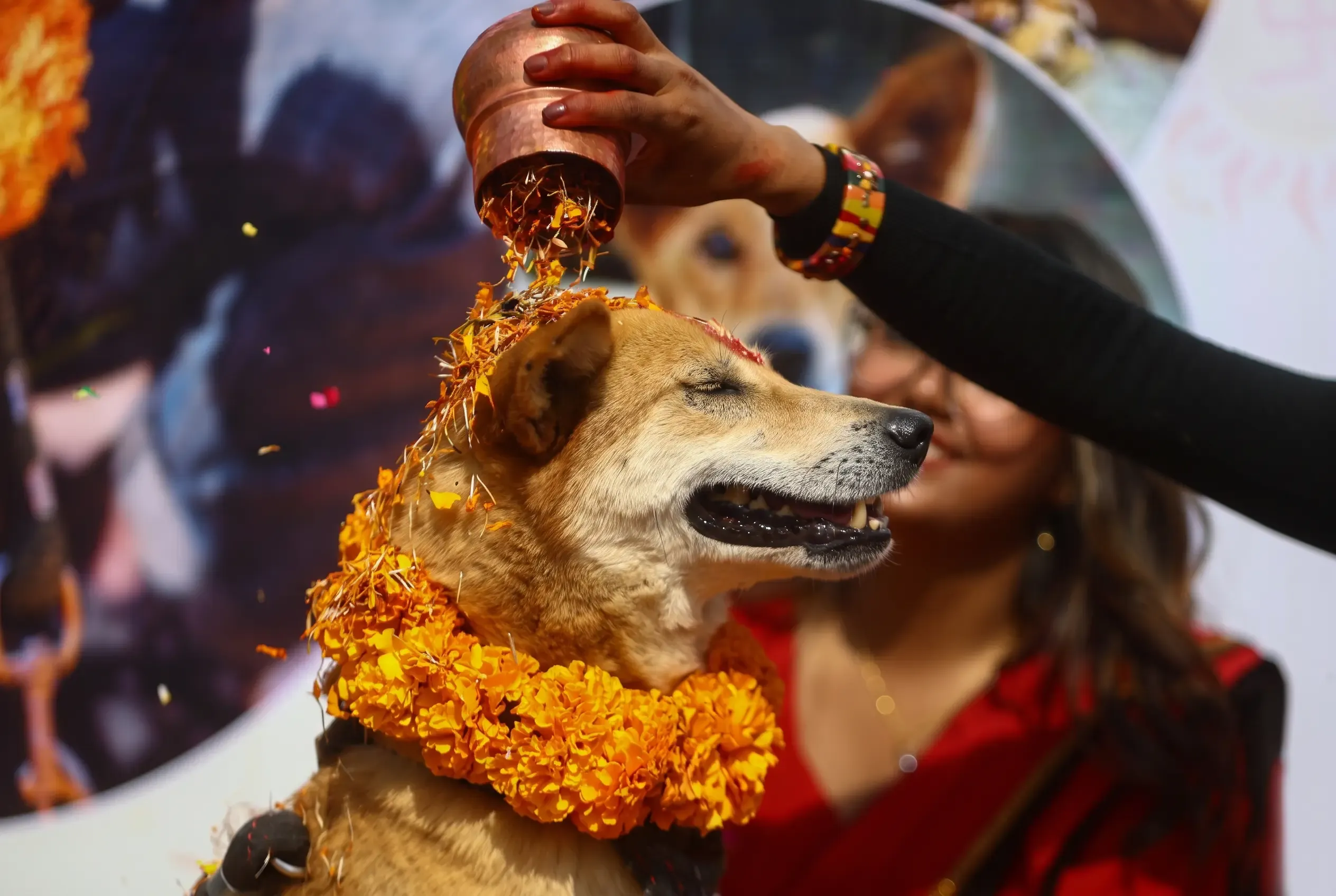
The Mahabharata runs to roughly 100,000 verses across eighteen books, and it is easy to miss that the whole thing is bracketed at both ends by a dog. The first story it tells is about a pup being beaten for nothing. The last scene before heaven opens is a king refusing to walk through the gate without one.
That is an odd animal to give the job to. The ancient Hindu law books, the Dharmashastra, treat dogs as a source of ritual pollution, and no story hands out its opening and its closing by accident.
The first story the epic tells is about a beaten pup
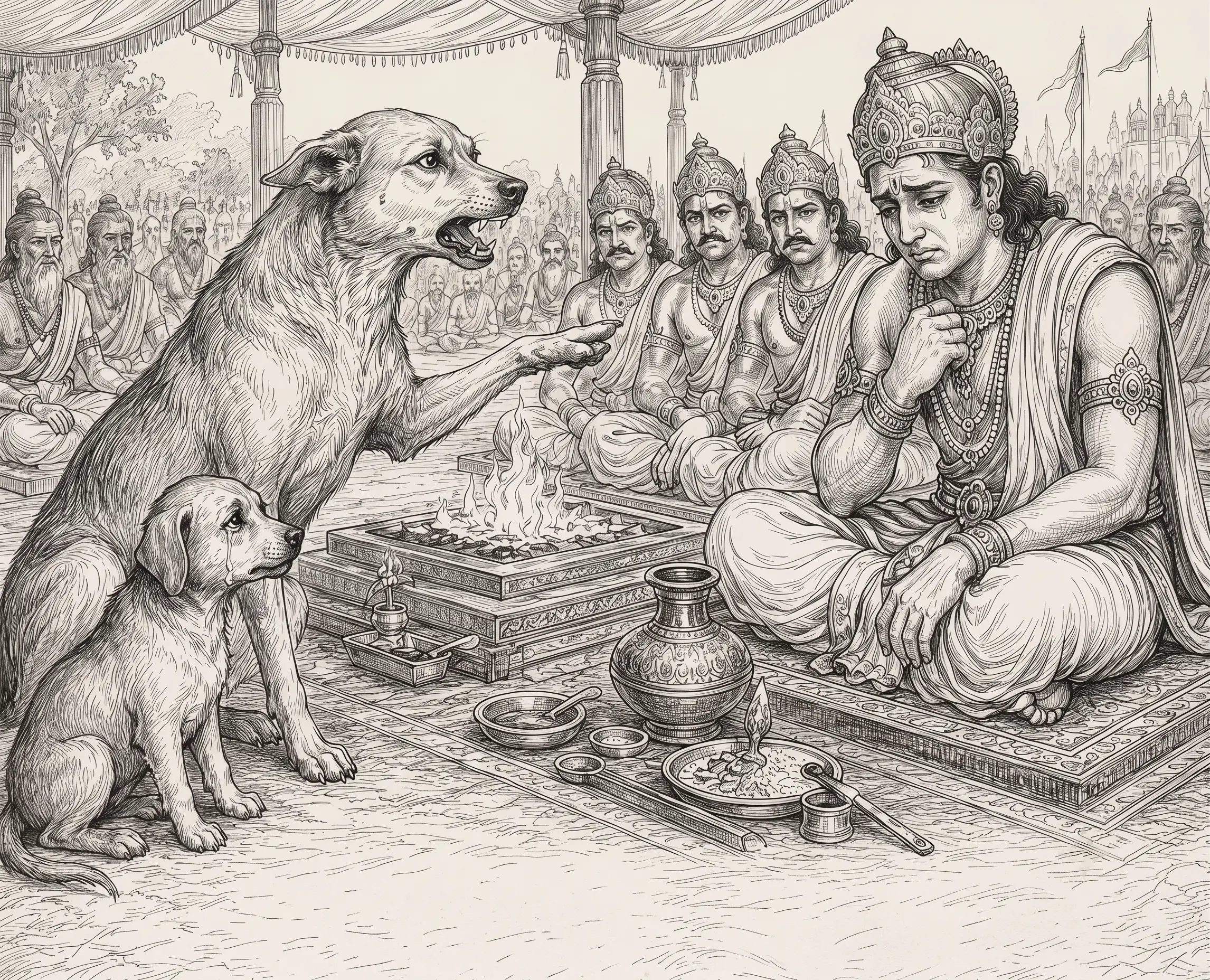
Book 1, the Adi Parva (each of the epic’s eighteen books is a parva), opens with an index and a summary of what is coming (Wikipedia’s breakdown of the Adi Parva), so the first actual narrative is the third sub-section, Paushya Parva, and it begins somewhere startlingly domestic. King Janamejaya is holding a long sacrifice on the plains of Kurukshetra with his three brothers, a pup wanders in, and the brothers beat it. It runs back to its mother, and its defence, in Kisari Mohan Ganguli’s nineteenth-century translation, is one of the more affecting lines in the whole epic because it is so small and so specific:
“I have not touched the sacrificial butter with my tongue, nor have I even cast a look upon it.”
The mother goes to the king and curses him. Here is the line itself:
“as ye have beat my son who hath committed no fault, therefore shall evil come upon ye when ye least expect it.”
In plain English, she is not naming a specific punishment. She is telling him that something bad will happen to him, and that he will not see it coming. Janamejaya, “exceedingly alarmed and dejected,” takes on a household priest to guard against it (Adi Parva, Section III, at Wikisource), but the curse does not surface for years, and by the time it does, everyone has long since stopped thinking about a beaten dog.
Janamejaya grows up, and his father Parikshit is killed by a snake-king named Takshaka. In revenge, Janamejaya launches the biggest undertaking of his reign: a sarpa satra, a sacrifice designed to burn the entire snake race alive, Takshaka included. It is going well. Priests chant in relays, snakes drop into the fire by the thousand, and Takshaka is finally cornered with nowhere left to hide. Then, with the ritual almost complete, a young brahmin named Astika walks in off the road. He has enough standing with the king to be offered a boon before anyone can stop him, and instead of asking for wealth or land, he asks Janamejaya to end the sacrifice. Janamejaya, bound by his own word, agrees, and lets Takshaka and every remaining snake go free, over the furious objections of the priests running the ritual (Wikipedia on Astika).
That is the curse landing. Nobody at that sacrifice saw Astika coming. He shows up, uninvited and unannounced, at the exact moment the king’s greatest project is closest to succeeding, and talks him into abandoning it. It costs Janamejaya the one thing he wanted most from that ritual: Takshaka, dead. Bad luck, on no schedule anyone could prepare for, wrecking the single undertaking the king cared most about finishing. That is precisely what the mother dog promised him.
The mother was not just any dog
She has a name, and an old one: Sarama. The Rig Veda, the oldest of the Hindu scriptures, knows her centuries before the epic does, as the hound of Indra, king of the gods, the one who tracks the cattle stolen by a demon tribe called the Panis and finds them by the path of truth. Hymn 10.108 is a dialogue in which the thieves offer her a share of the loot and a place as their sister, and she turns them down flat. Her other name is Devashuni, the she-dog of the gods (Wikipedia’s article on Sarama).
Her sons are the reason dogs stand at the edge of death in Indian thought. The hymn to Yama, god of the dead, at Rig Veda 10.14, sends the departing soul past two guardians:
“Run and outspeed the two dogs, Saramā’s offspring, brindled, four-eyed, upon thy happy pathway.”
That is verse 10.14.10 in Griffith’s translation (Rig Veda 10.14.10 at Wisdomlib). The two are Sharvara, “spotted,” and Shyama, “dark,” the four-eyed watchdogs of Yama’s road, cast in the Atharvaveda, a later Vedic collection, as the messengers who come to mark out who is about to die (Wikipedia on Sharvara and Shyama).
So by the time a pup gets kicked at Janamejaya’s sacrifice, the audience already knows whose pup it is, and knows exactly what that carelessness is inviting.
The dog that walks to the gate of heaven
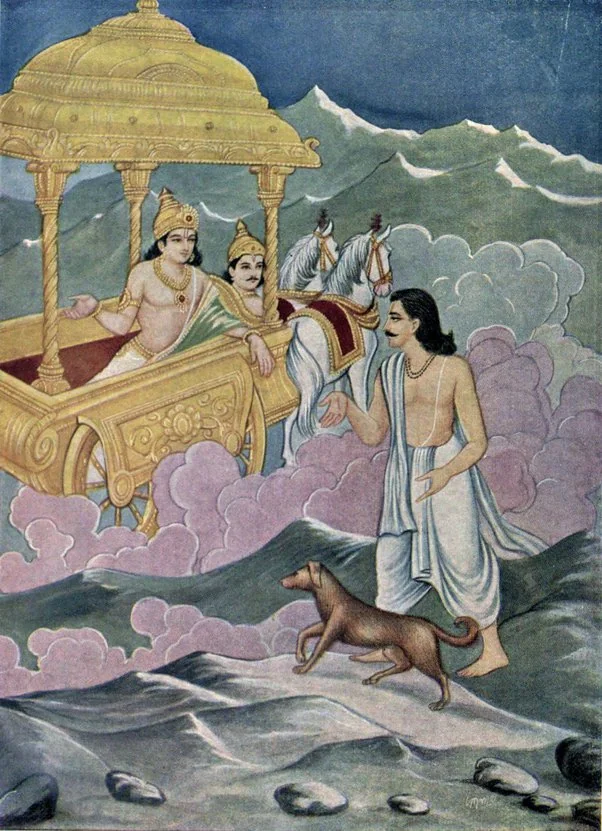
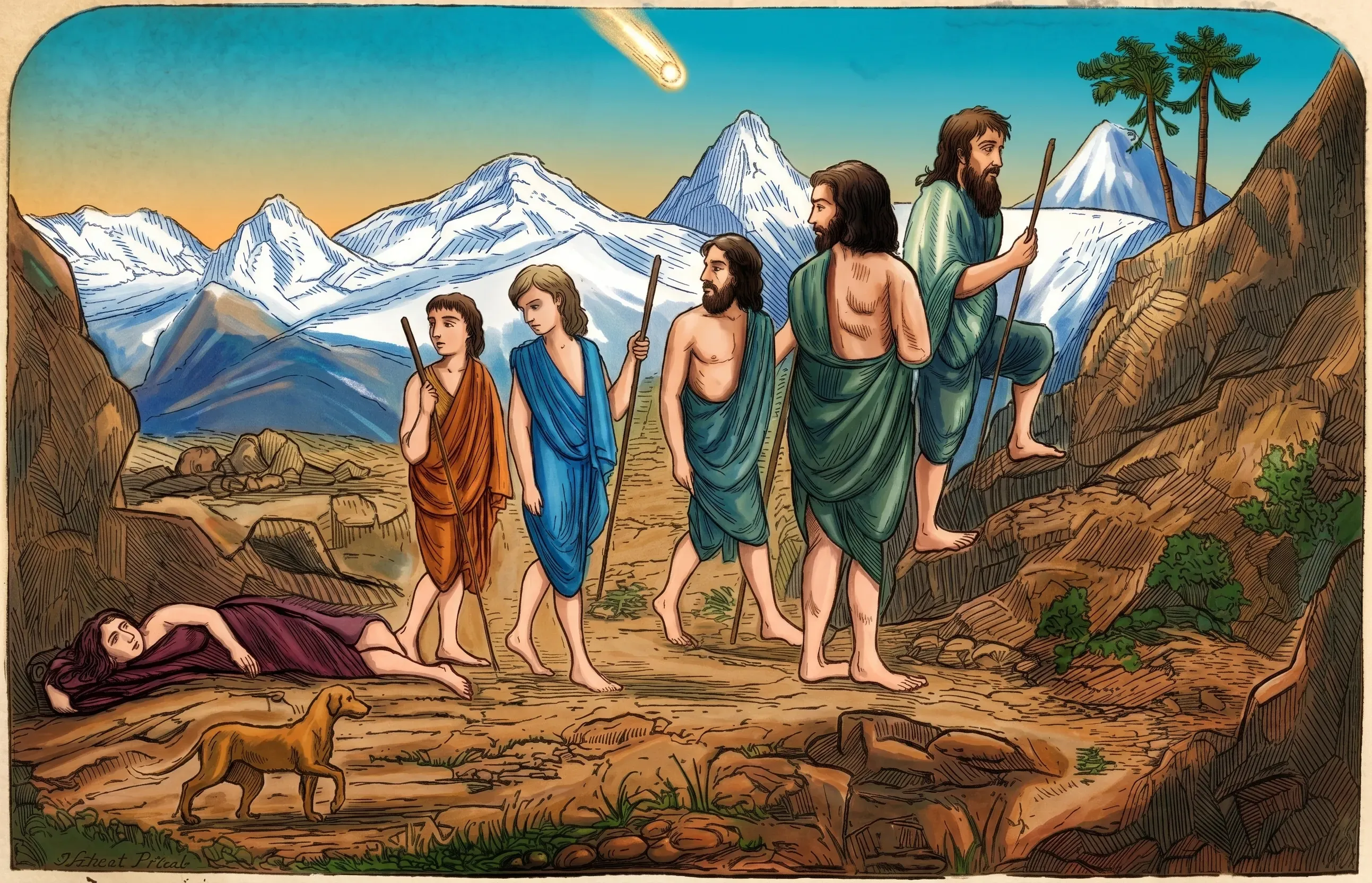
Book 17, the Mahaprasthanika Parva, is the shortest in the epic. After the war and the thirty-six years of rule that follow it, the five Pandava brothers, the epic’s heroes, give everything up and walk north (Wikipedia on the Mahaprasthanika Parva). A dog attaches itself to them on the way. Nobody adopts it or names it; it simply comes along, the way dogs in India have always come along.
Then they start dying, one by one, and each time Yudhishthira names the flaw out loud as he keeps walking without looking back. Draupadi falls first, for loving Arjuna more than her other four husbands. Then Sahadeva, for being too proud of his own intellect. Then Nakula, for vanity about his looks. Then Arjuna, who had once boasted he would destroy every enemy of the Pandavas in a single day and never lived up to it. Then Bhima, for gluttony and boasting about his own strength. By the time Yudhishthira is climbing toward Mount Meru, the mountain at the centre of the world in Hindu cosmology, there are two of them left: the king, and the dog (Mahaprasthanika Parva, Section II, at Wikisource).
Indra, king of the gods, arrives with a chariot to take Yudhishthira up to heaven in his own body, a rare honour. Yudhishthira is ready to go, but he asks that the dog come with him. That is where the conversation turns strange. Indra says no, and he does not say no out of dislike for the dog. He says no because heaven has a rule about it:
“There is no place in Heaven for persons with dogs. Besides, the (deities called) Krodhavaças take away all the merits of such persons.”
The objection is technical: the dog is a purity problem. Yudhishthira refuses the entire frame.
“O thou of a thousand eyes, O thou that art of righteous behaviour, it is exceedingly difficult for one that is of righteous behaviour to perpetrate an act that is unrighteous.”
Indra pushes back, telling him he left his own brothers and his wife lying on the mountain. Yudhishthira’s reply is precise. He could not restore them once they were dead, and there is neither friendship nor enmity with the dead, whereas the dog is still alive; abandoning one who is devoted to you, he says, carries the same weight as killing a brahmin. He will not abandon the frightened, the devoted, the weak, or anyone seeking his protection, not while he draws breath. Then the text turns:
“Hearing these words of king Yudhishthira the just, (the dog became transformed into) the deity of Righteousness, who, well pleased, said these words unto him in a sweet voice fraught with praise.”
It is Dharma, the god of right conduct, who is also Yudhishthira’s own father. He tells him he has just earned something no chariot ride could have given him (Mahaprasthanika Parva, Section III, at Wikisource). Some retellings say Yama instead, which is close enough to be fair, since Yama also carries the title Dharmaraja, lord of dharma. But the text’s own word is Dharma.
One test still remains. In Book 18 Yudhishthira reaches heaven, sees the wicked seemingly enthroned and his own brothers seemingly in hell, and asks to be sent to hell with them too. It turns out to be one more illusion (Wikipedia on the Svargarohana Parva). The pattern holds all the way to the end: offered comfort at someone else’s cost, Yudhishthira always says no. The dog was just the first and hardest time he had to prove it, because the dog was the one with no claim on him at all.
The two dogs, side by side
| The dog at the beginning | The dog at the end | |
|---|---|---|
| Book | Adi Parva (Book 1), Paushya sub-parva | Mahaprasthanika Parva (Book 17), Section III |
| Where in the epic | The first narrative episode, after the index and summary sections | The final scene before heaven, one book from the close |
| Setting | Janamejaya’s long sacrifice on the plains of Kurukshetra | The climb toward Mount Meru, after the Pandavas renounce the kingdom |
| The dog | An unnamed pup, a Sarameya, offspring of Sarama | An unnamed stray that follows the Pandavas the whole way |
| What the humans do | Srutasena, Ugrasena and Bhimasena beat it without cause | Yudhishthira refuses Indra’s chariot rather than leave it behind |
| The objection raised | An animal at the sacrificial ground is a pollution risk | “There is no place in Heaven for persons with dogs” — the Krodhavasas |
| Divine identity | Sarama, the devashuni, Indra’s hound from the Rig Veda | Dharma, the deity of Righteousness, Yudhishthira’s own father |
| Consequence | A curse: evil “when ye least expect it” — and the snake sacrifice is later halted unfinished | Yudhishthira enters heaven in his mortal body, praised for the refusal |
Sources for the table: Ganguli’s translation of Adi Parva, Section III and Mahaprasthanika Parva, Section III, with structural detail from Wikipedia’s articles on the Adi Parva and Mahaprasthanika Parva.
Read the two columns across and the symmetry is hard to unsee: the same animal, the same lack of a name, the same ritual objection raised by the humans in charge, and the exact opposite answer with the exact opposite outcome.
Which dogs were these, actually
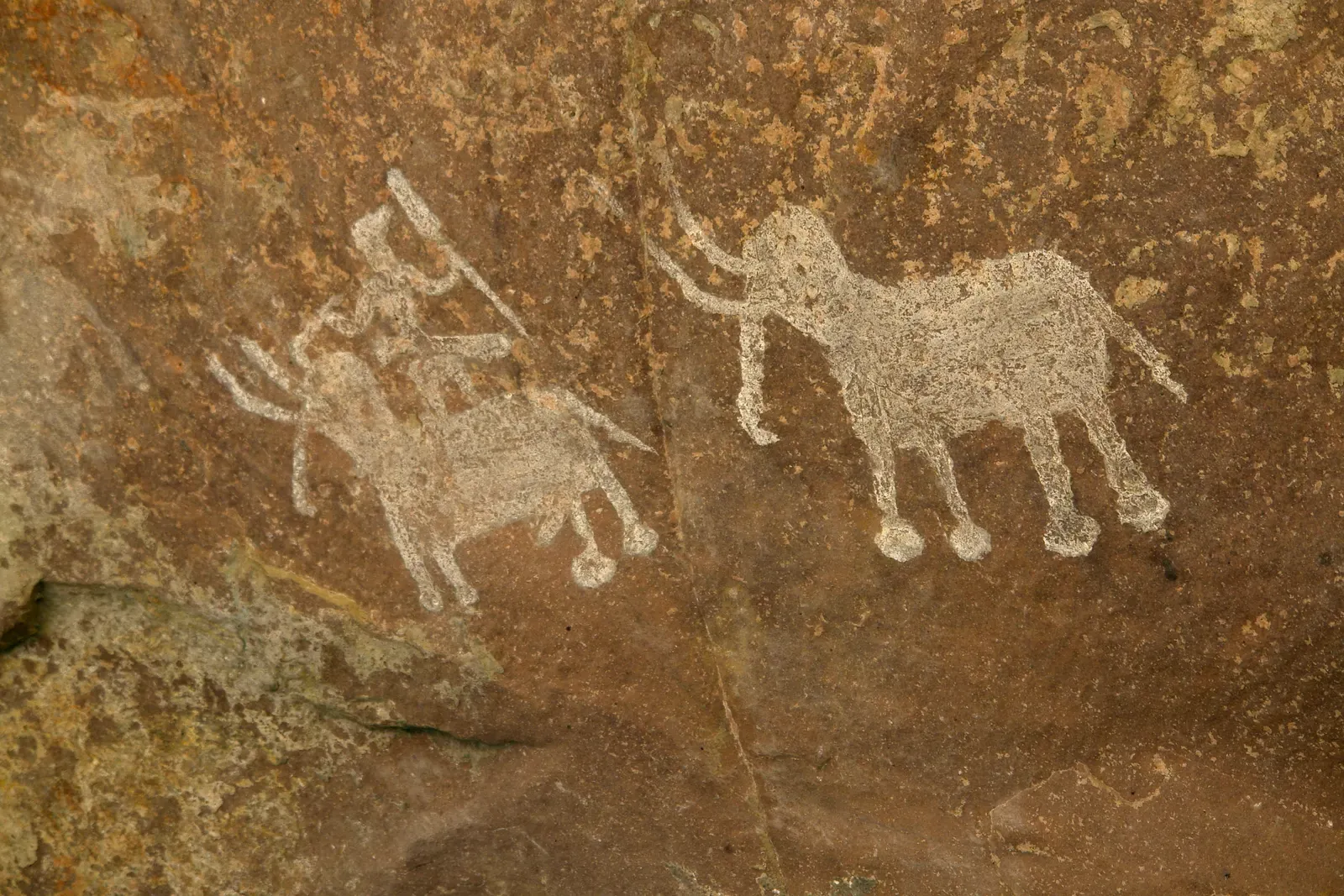
The text never describes the dog: no breed, no colour, no size, for either one. But there was really only one kind of dog around to be it. The epic was composed while the free-ranging native dog was the only dog on the subcontinent, and the evidence backs that up well beyond the epic’s own timeframe: a Mohenjo-daro skull identified as close kin to the Indian pariah dog, and a 2015 genetics study showing India’s village dogs carry an old, largely unmixed lineage rather than a mix of escaped colonial breeds. We’ve traced that fuller history separately, from rock art to the genetics.
So the pup that hadn’t licked the butter, and the dog on the mountain path, were near enough the dog outside your building: medium build, short coat, ears up, tail curled over the back, no owner. The breed has a written standard now, published in 2015 under the name INDog (Wikipedia on the Indian pariah dog). The standard is about four thousand years late.
The dog is still standing outside the gate
The English word we hang on this dog, pariah, has the same shape as that old contempt: a caste term for human beings, generalised into an insult, then pinned on an animal. Different language, same move, centuries apart.
The Mahabharata put a dog at both ends of its longest story and made the treatment of that dog the measure of a king who had already won a world war. Janamejaya’s brothers failed the test in the first chapter and Yudhishthira passed it in the last, and both times the dog had done nothing, asked for nothing, and simply turned up.
That is still the whole test, and it is still open. Yudhishthira needed a chariot, a god, and the gates of heaven in front of him before he made the right call. The dog outside your building will settle for a bowl of water and a kind word, and unlike the king, you do not need to be tested to give it.
Common questions
Does the Mahabharata really begin and end with a dog?
Effectively, yes. The first narrative episode in the epic, in the Paushya sub-parva of Book 1, is the beating of Sarama’s pup at Janamejaya’s sacrifice; the last scene before Yudhishthira enters heaven, in Book 17, is his refusal to abandon a dog. The opening chapters of Book 1 are an index and a summary rather than story. See The first story the epic tells is about a beaten pup.
What exactly was Sarama’s curse on Janamejaya?
In Kisari Mohan Ganguli’s translation, Sarama tells the king and his brothers: “as ye have beat my son who hath committed no fault, therefore shall evil come upon ye when ye least expect it.” Janamejaya’s later snake sacrifice is in fact halted before completion, when the young sage Astika asks him to stop. See The first story the epic tells is about a beaten pup.
Why did Yudhishthira refuse to enter heaven without the dog?
Indra objected on grounds of ritual purity, saying heaven has no place for people with dogs. Yudhishthira answered that abandoning one who is devoted to you is as sinful as killing a brahmin priest, and that he never abandons the frightened, the devoted, the weak or anyone seeking his protection. The dog then revealed itself as Dharma. See The dog that walks to the gate of heaven.
Was the dog Yama or Dharma?
Ganguli’s text has the dog become “the deity of Righteousness” — Dharma, who is Yudhishthira’s own father. Many popular retellings say Yama instead, which isn’t really a contradiction, since Yama also carries the title Dharmaraja. See The dog that walks to the gate of heaven.
Who is Sarama in Hindu texts?
Sarama is the hound of Indra, king of the gods, in the Rig Veda, the oldest of the Hindu scriptures, where she is called Devashuni, the she-dog of the gods. She tracks down the cattle stolen by the Panis in hymn 10.108 and refuses their bribe. Her sons Sharvara and Shyama are the four-eyed dogs guarding the road of the dead in the Yama hymn, Rig Veda 10.14. See The mother was not just any dog.
Were the dogs in the Mahabharata Indian pariah dogs?
The text never describes them, so this is inference rather than stated fact, but the free-ranging native dog was the only dog population on the subcontinent at the time. A Mohenjo-daro skull from 2600–1600 BCE was described by its examiners as closely related to the Indian pariah, and 2015 genetic work found Indian village dogs carry high diversity with little European-breed admixture. See Which dogs were these, actually.
Sources
- The Mahabharata, Book 1: Adi Parva, Section III — Kisari Mohan Ganguli translation, Wikisource
- The Mahabharata, Book 17: Mahaprasthanika Parva, Section II — Kisari Mohan Ganguli translation, Wikisource
- The Mahabharata, Book 17: Mahaprasthanika Parva, Section III — Kisari Mohan Ganguli translation, Wikisource
- Mahabharata — Wikipedia
- Adi Parva — Wikipedia
- Mahaprasthanika Parva — Wikipedia
- Svargarohana Parva — Wikipedia
- Astika (sage) — Wikipedia
- Sarama — Wikipedia
- Sharvara and Shyama — Wikipedia
- Rig Veda 10.14.10, Griffith translation — Wisdomlib
- Archaeological Record for the Domestic Dog, Canis familiaris, in India — The INDog Project
- Central Asian village dogs closest to original dogs (Shannon et al., PNAS 2015) — Cornell Chronicle
- Indian pariah dog — Wikipedia