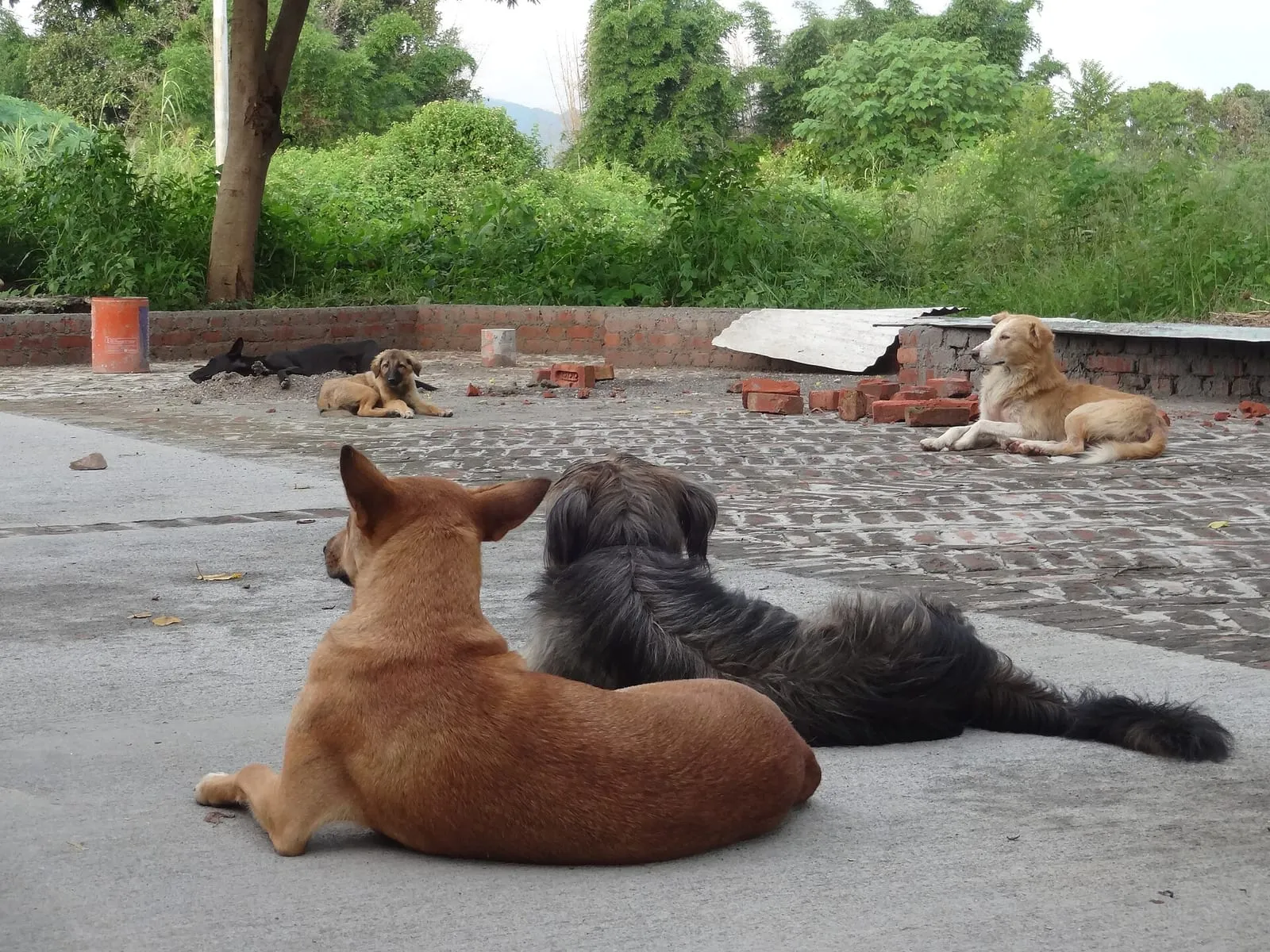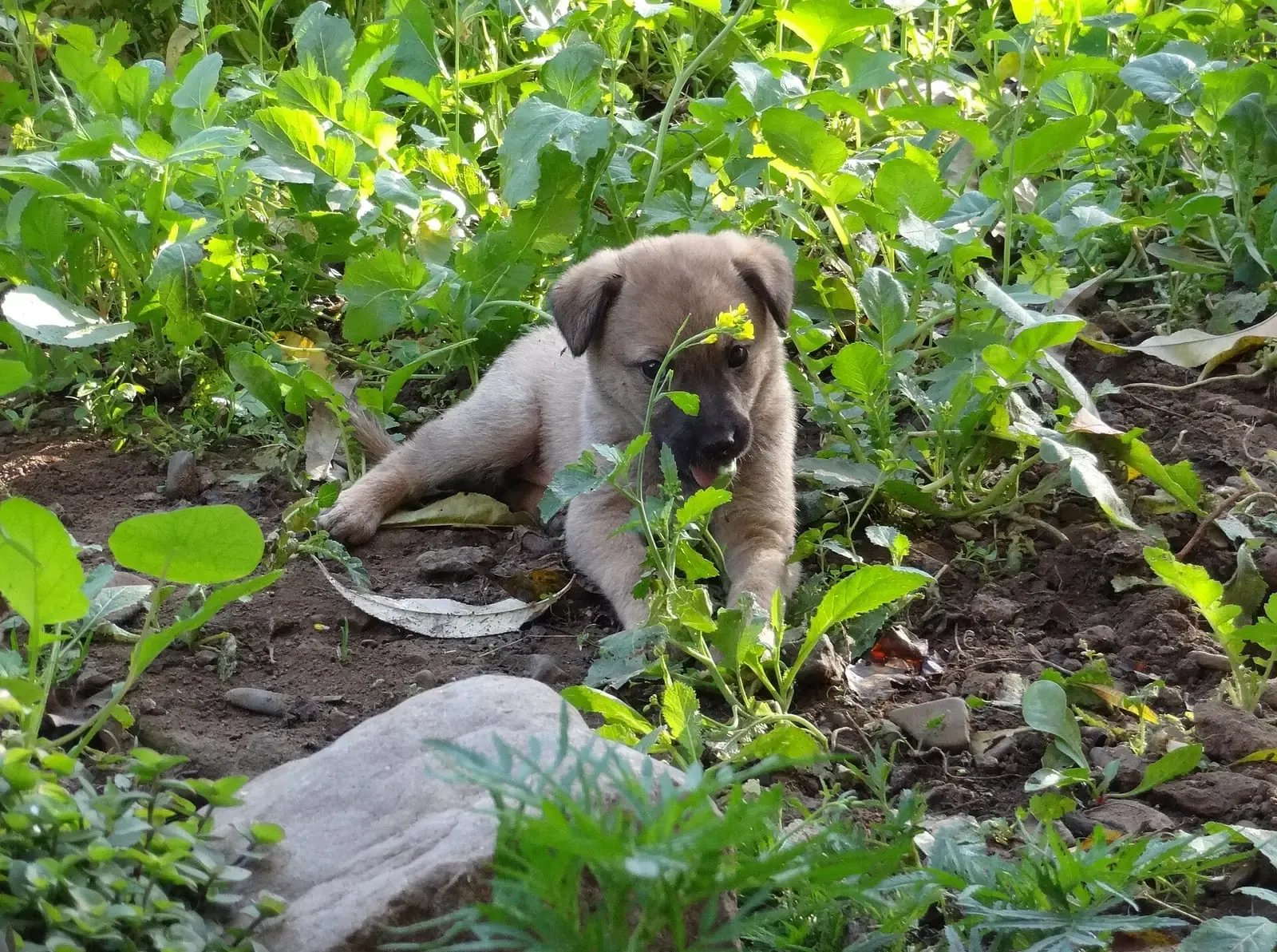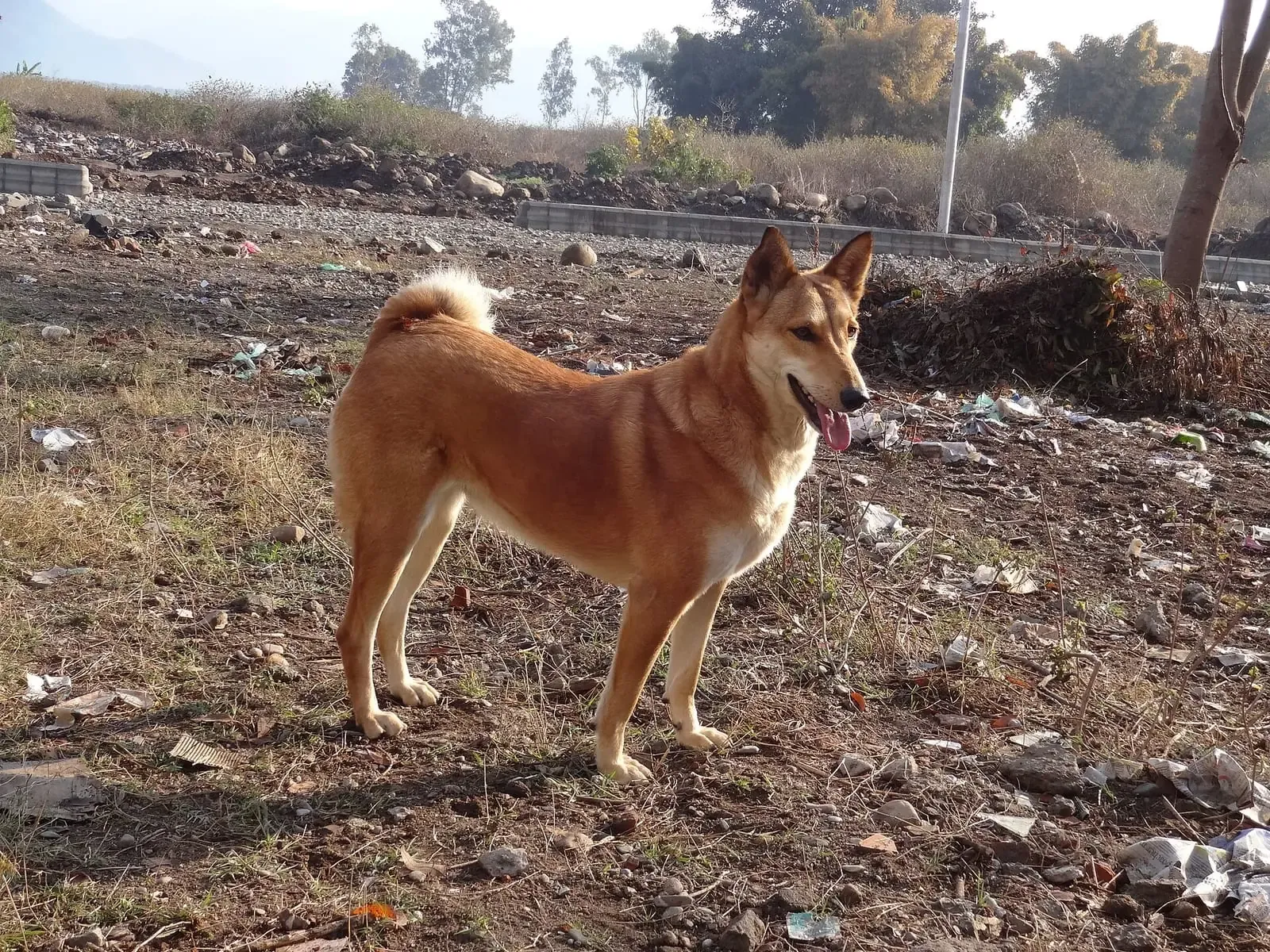
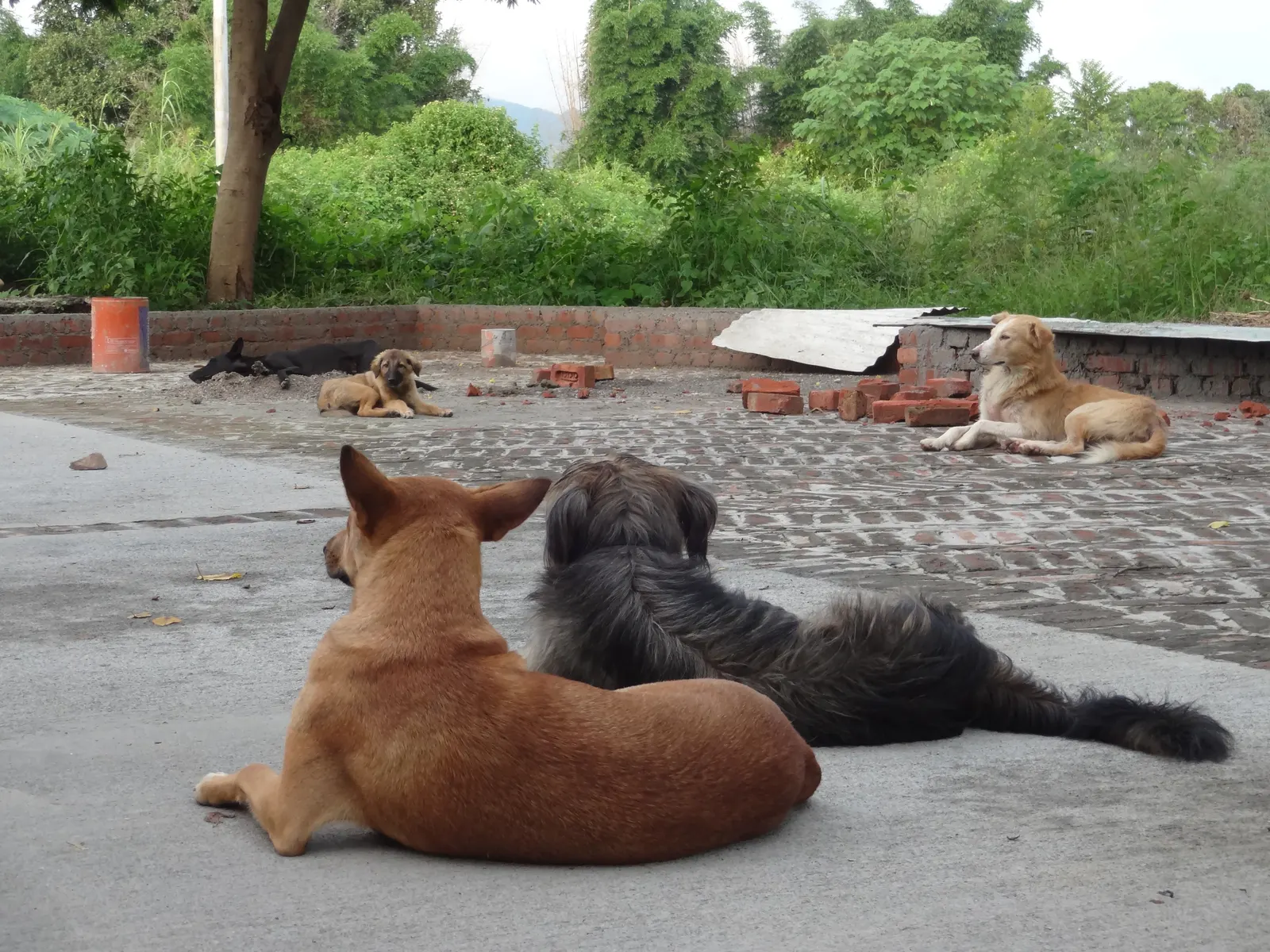
Walk through almost any Indian town and you’ll see this dog: medium build, short coat, curled tail, ears that never fold over. People usually call it a stray, as if it wandered in from nowhere. It didn’t. That exact body plan shows up on a terracotta figurine dug out of a four-thousand-year-old city, and again on rock-shelter paintings that may be thousands of years older. Nobody bred this dog on purpose. India did, over a span the rock art suggests could reach nine thousand years, without ever writing the process down.
Here’s what the record actually shows, skipping the folklore: the rock art, the digs, the paperwork.
Painted on stone before anyone kept records
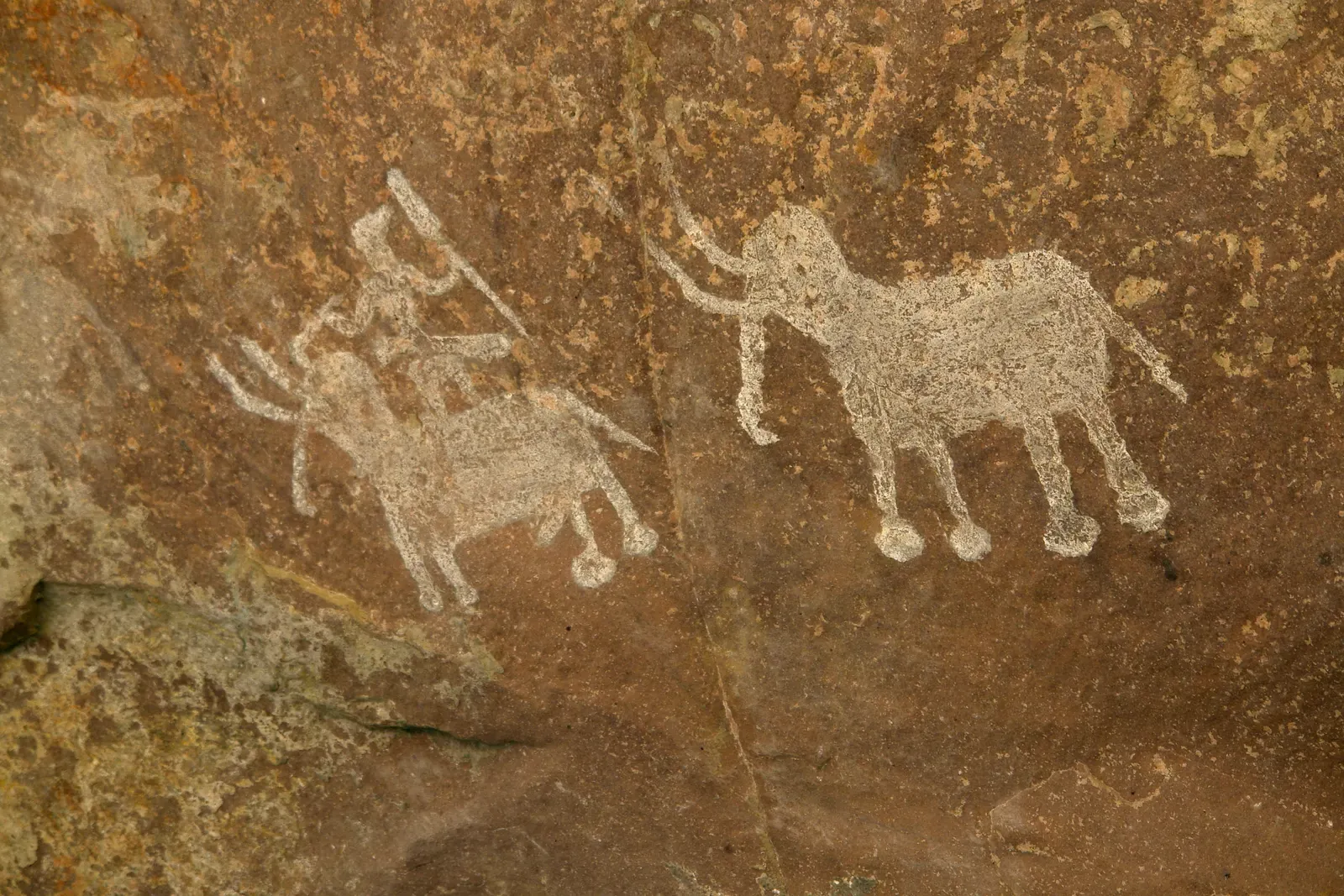
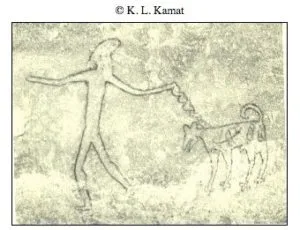
The earliest evidence isn’t a bone. It’s paint. At the Bhimbetka rock shelters near Bhopal, a UNESCO site now but a cluster of overhangs then, prehistoric artists covered the walls with hunts, dances, and daily life stretching from the Mesolithic well into the historic period. Dogs are everywhere in it. Art historian Yashodhar Mathpal counted 41 separate dog drawings across 21 of the shelters, in eight different pigments, when he surveyed the site for his 1984 book Prehistoric Rock Paintings of Bhimbetka. Fourteen were from the Mesolithic, eight from a transitional phase, nineteen from the historic period, per the INDog Project’s archaeological survey.
One Chalcolithic-era panel, at a spot called Kharwai, shows a hunter closing in while his dog attacks the prey from behind. A later one, from the historic layer, shows a warrior on campaign with a dog on a leash: curled tail, ears up, the works, as art historian Erwin Neumayer described it in his own 1983 survey of the region’s rock paintings, also cited by the INDog Project. These aren’t wild animals that wandered into frame. They’re already on the job.
Then the cities show up
Fast forward to the Indus Valley Civilisation, roughly 3300 to 1300 BCE, and the dog has moved from cave paintings into actual streets. The Archaeozoology Laboratory at Deccan College, working from research led by P. K. Thomas and Pramod Joglekar, has logged dog bones at 23 separate Harappan-period sites: Harappa itself, Kalibangan, Lothal, Rupar, Surkotada, and others across what’s now Pakistan and northwestern India, according to the INDog Project’s archaeological survey. At one of those sites, Jaidak, the dog bones carried no butchery marks at all. The excavators read that as a sign the animals were kept, not eaten.
The single most-cited specimen is a skull John Marshall dug out of Mohenjo-daro in the early 1930s, dated to somewhere between 2600 and 1600 BCE. When the zoologists who examined it, Colonel R. B. Seymour Sewell and B. S. Guha, wrote it up, they said it came close to “one of the domestic or semi-domestic dogs that are so common at the present day around every Indian village.” That’s a four-thousand-year-old skull, described in terms that could apply to the dog asleep outside your building right now, per the same INDog Project survey.
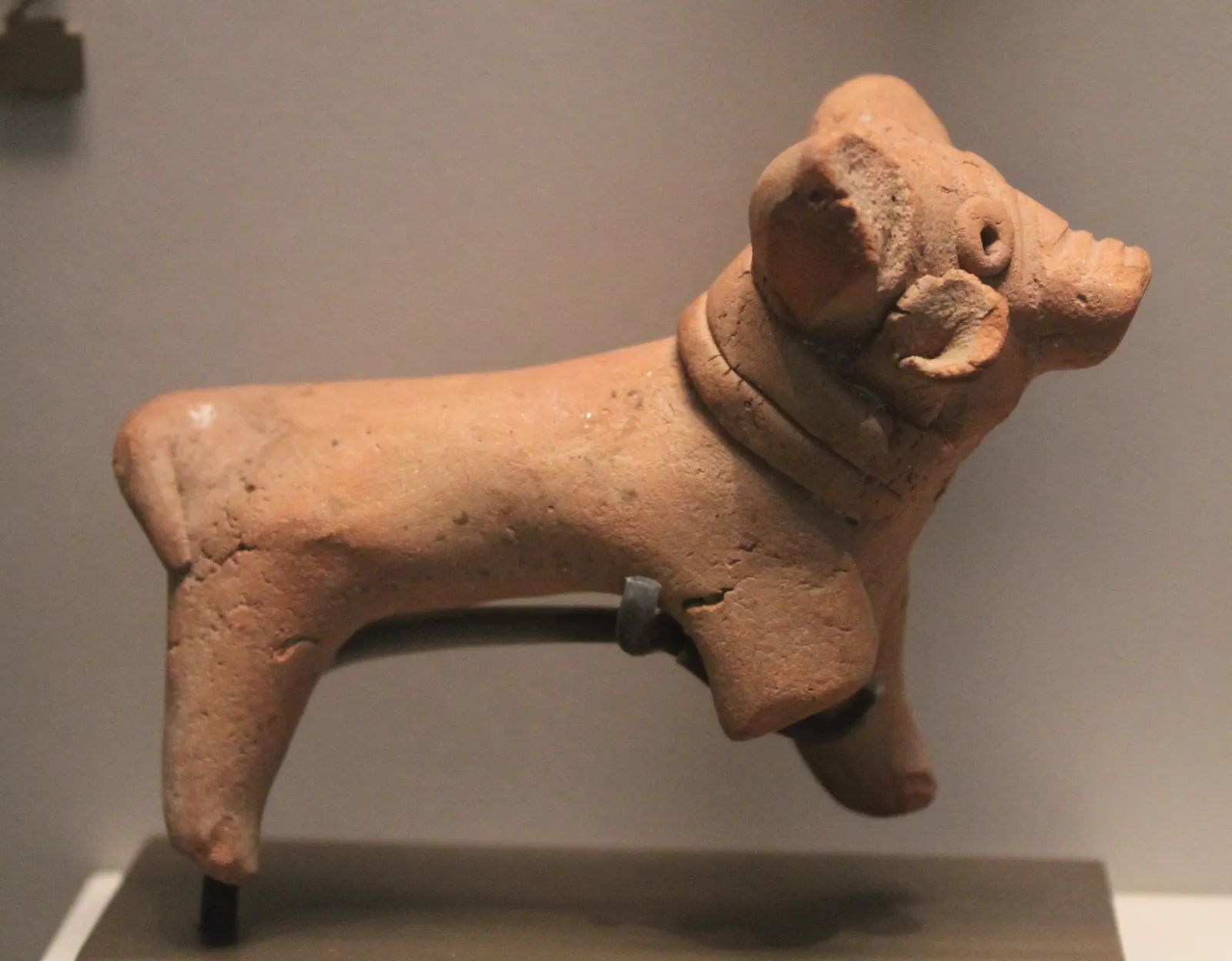
The figurines are the part that gets me, honestly. Indus Valley craftsmen modeled dogs wearing collars, not generic scavengers but actual pets with actual hardware. One of these, pulled from Harappa and now sitting in the Musée Guimet in Paris on loan from Delhi’s National Museum, has a distinct raised collar around its neck, a feature you can still see on working dogs in Indian villages today.
Word got around
India’s dogs didn’t stay a local story. Pliny the Elder wrote them up in the first century CE as unusually large and formidable. High praise from a Roman who’d presumably seen plenty of dogs. Older sources go further: ancient historians record that Sopeithes, a ruler in the Gandhara region, gave Alexander the Great 150 hunting dogs as a gift, which only makes sense as a gesture if those dogs already had a reputation worth showing off (GoofyTails has a good rundown of the classical-era references).
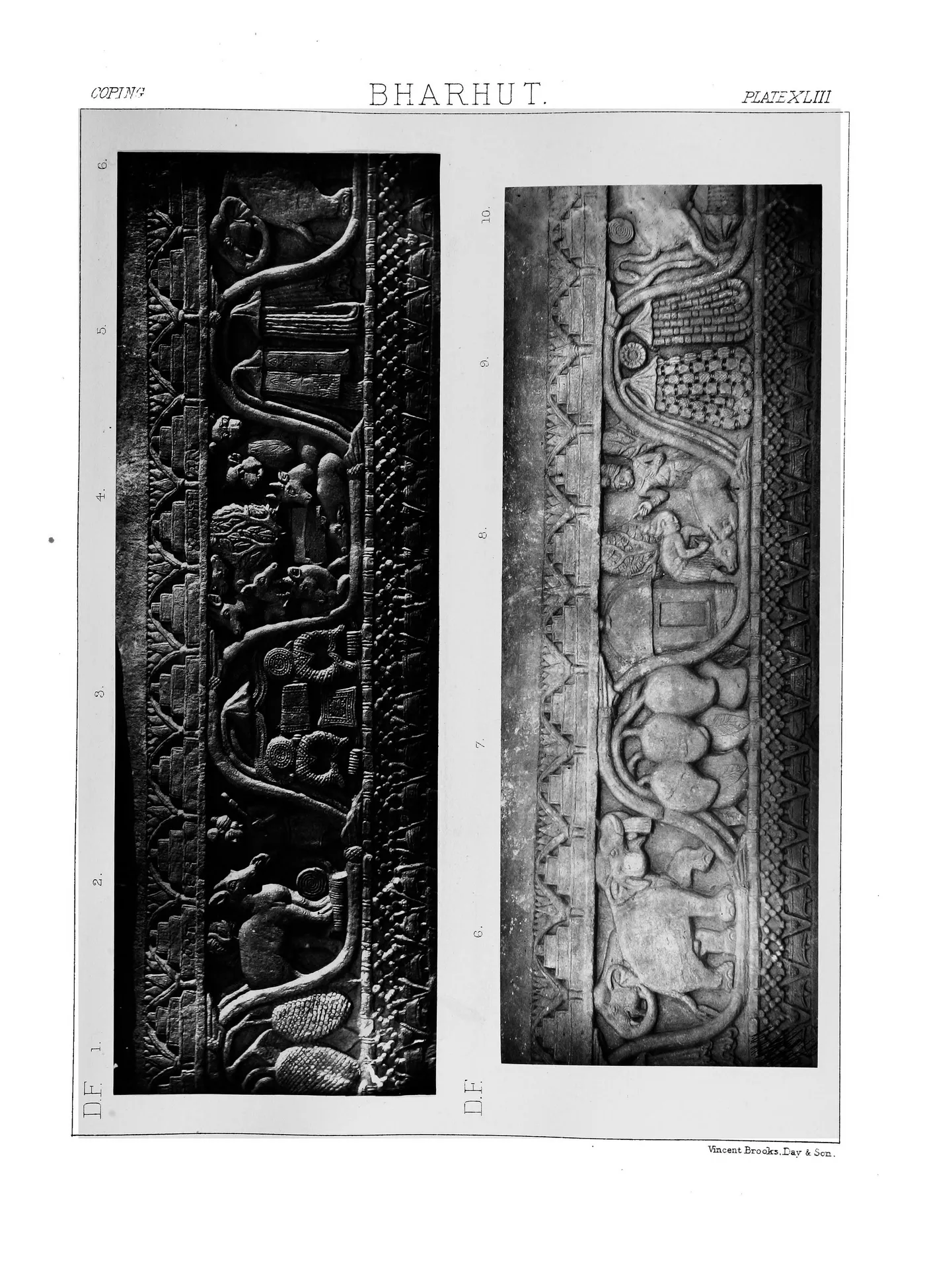
They traveled further than Macedonia, too. The genetic case for where Australia’s dingo came from points to dogs from the Indian subcontinent, carried over by seafaring traders something like 4,300 years ago. And back home, a coping stone from the Bharhut Stupa railing, carved in the third or second century BCE, shows a small Jataka scene the excavator Alexander Cunningham catalogued as the Uda Jātaka: a seated rishi with a pair of dogs and a pair of cats by a fish pond, the dogs at play over a bone while the cats squabble over a fish. Cunningham published a photograph of it as Plate XLIII in his 1879 survey of the site, and it’s also cited by the INDog Project’s archaeological summary. Their version is cropped in tight on the animals; the worn original carving is much harder to make out.
Nobody was breeding this dog
This is the detail that actually makes it interesting: nobody selected for any of this. The Indian pariah dog is a landrace, not a breed: there was never a founder, a club, or a written standard. What shaped it was just survival, run over thousands of generations in real Indian villages and cities. Dogs that read people well, tolerated heat, and shrugged off local disease had puppies. The rest didn’t. That’s the whole mechanism.
It produced something oddly consistent across a huge stretch of territory: the same medium build, short coat, erect ears and curled tail from Punjab down to Kerala, and out into Pakistan, Bangladesh, Nepal, Sri Lanka and Afghanistan. It also wasn’t the only type India had. An eighteenth-century French traveler recorded roughly fifty distinct kinds of Indian dog on his journey through the subcontinent; by the reckoning in a recent Splainer feature on Indian dog history, only about half of those are still around as recognizable populations. Nobody was tracking that loss while it happened.
Then came the word “pariah”
This is where the story turns ugly, and where the dog’s actual name comes from. “Pariah” is borrowed from Tamil paṟaiyar (drummer), a community that made and played the parai drum and, because of that work, was placed at the bottom of the traditional caste order, according to Wiktionary’s etymology entry. The British picked the word up and widened it into a general insult for anyone, or anything, they considered low-status. India’s street dogs got swept into that basket right along with people, and the label never really came off. The first recorded use of the phrase “yellow pariah dog” is Rudyard Kipling’s, in The Jungle Book, according to Language Log’s linguistic history of the term. British soldiers later shortened it further, to “pye-dog,” a contraction the 1886 Anglo-Indian dictionary Hobson-Jobson recorded directly.
It wasn’t just a slur. It had teeth. A 1902 memo from G. Strokes, Chief Secretary to the Government of Madras, called street dogs “one of the lowest type of canine genus” and said their destruction was “indispensable.” Numbers backed the sentiment up: Bombay killed roughly 63,000 dogs between 1823 and 1832, and Calcutta was destroying close to 12,000 a year in the early 1900s, by shooting, poison, and electrified lethal chambers, according to reporting in ThePrint. Bombay’s 1832 cull went far enough that it set off riots, with dog catchers entering homes and killing pets outright. Parsis, for whom dogs carry real religious weight, led the resistance; shops shut, supply lines were blocked, and the colonial government eventually backed off mass killing in favor of relocating dogs outside the city, per Wikipedia’s account of the Bombay Dog Riots.
Meanwhile, the Kennel Clubs the British set up in India ran shows that were, in practice, stages for imported European breeds. Merchants selling those pedigree dogs had every reason to talk down the native dog’s intelligence, and they did. A dog that had guarded Indian homes for four thousand years got rebranded, in the space of a couple of generations, as a nuisance with no pedigree worth mentioning.
Taking the name back
That rebranding has been unwinding slowly, mostly through the efforts of enthusiasts who’d rather call this dog what it is. “Indian Native Dog” (INDog for short), or simply “desi dog,” have become the preferred terms, language that describes the animal instead of insulting it. In 2015 the Kennel Club of India put that shift on paper, publishing a formal INDog breed standard in the Indian Kennel Gazette. The type has since picked up recognition abroad too, through the Primitive and Aboriginal Dog Society, as noted on Wikipedia. It’s not a dramatic reversal. It’s a paper trail finally catching up to four thousand years of evidence.
What’s actually different now
Set the Bhimbetka paintings next to a photo of any street dog today and the resemblance is uncomfortable, in a good way: same ears, same tail, same wary confidence around people. Thousands of years of that, and nobody was ever holding a clipboard.
What’s changed is smaller than it sounds: a breed standard on paper, a handful of conservation-minded owners, and a growing trickle of exports to dog lovers abroad who’ve discovered what Indian villages already knew. Whether any of that reshapes the dog the way four thousand years of just living here never did, I genuinely don’t know. Ask again in a century.
Common questions
Is the Indian pariah dog a breed or a landrace?
A landrace, not a bred breed. There was never a founder, a breed club, or a written standard behind it. See Nobody was breeding this dog above.
How old is the Indian pariah dog?
Possibly up to about 9,000 years, going by the Mesolithic dog paintings at Bhimbetka, though rock-art dating is less certain than bone evidence. The more secure archaeological record, bones and figurines, starts around 4,000 years ago at Harappan-period sites like Mohenjo-daro. See Painted on stone before anyone kept records.
Is the Indian pariah dog related to the dingo?
Yes. Genetic and archaeological evidence points to Australia’s dingo descending from dogs carried over from the Indian subcontinent by seafaring traders roughly 4,300 years ago. See Word got around.
Why are they called “pariah” dogs?
The British generalized “pariah,” borrowed from the Tamil caste term paṟaiyar, into an insult for anyone or anything they considered low-status, and it stuck to India’s street dogs. See Then came the word “pariah”.
What’s the difference between INDog, desi dog, and pye-dog?
All three describe the same landrace. “INDog” and “desi dog” are the modern, non-derogatory terms enthusiasts now prefer; “pye-dog” is the older British-soldier contraction of “pariah dog.” See Taking the name back.
Sources
- Indian pariah dog — Wikipedia
- Archaeological Record for the Domestic Dog, Canis familiaris, in India — The INDog Project
- Indian Pariah Dog — GoofyTails
- The other purebred: History of Indian dogs — Splainer
- How the British Raj determined what kind of dog was acceptable in India — ThePrint
- Bombay Dog Riots — Wikipedia
- pariah — Wiktionary
- Pariah dogs and pariah people — Language Log
- Alexander Cunningham, The Stûpa of Bharhut (1879) — Internet Archive