The first sign is usually sound: nails clicking against the kitchen tiles where a few weeks ago there was just the quiet pad of paws. It’s an easy thing to put off. The dog isn’t complaining, the nails don’t look dramatic, and clippers near a paw rarely get a warm welcome. But nail length is one of the few grooming jobs on a short-coated dog that changes how it actually moves, not just how it looks.
Read this first. This article is general information, not veterinary advice. The right nail-care routine depends on your dog’s age, health, nail colour and temperament. Confirm anything you’re unsure about with a licensed vet or groomer, and see a vet if bleeding from a nail doesn’t stop within about 15 minutes, if a nail is torn or split, or if you notice swelling, limping or discharge.
Why nail length actually matters
A dog’s weight should land on its paw pads, not its nails. Once a nail is long enough to touch the ground as the dog stands, it pushes back into the nail bed with every step, and the toe twists to compensate. Over time that can mean splayed feet, reduced traction, and, per the American Kennel Club, deformed feet and injured tendons. A grooming-industry source describes the same process from the dog’s side: compensating for sore, overgrown nails “can develop long-term musculoskeletal problems, leading to chronic pain and reduced mobility” (Pet Evolution). In the worst, long-neglected cases, a curled nail grows into the pad itself.
None of this happens overnight, which is exactly why it’s easy to miss when you see the dog every day.
How often an INDog actually needs a trim
Most dogs need a trim every three to four weeks. AKC and PetMD agree on that window; PetMD quotes vet Dr. Sarah Karwacki noting dogs walked on concrete “will file their nails naturally and may not need nail trims as often” as dogs mostly on grass, carpet or tile. VCA Hospitals puts the baseline at about once a month.
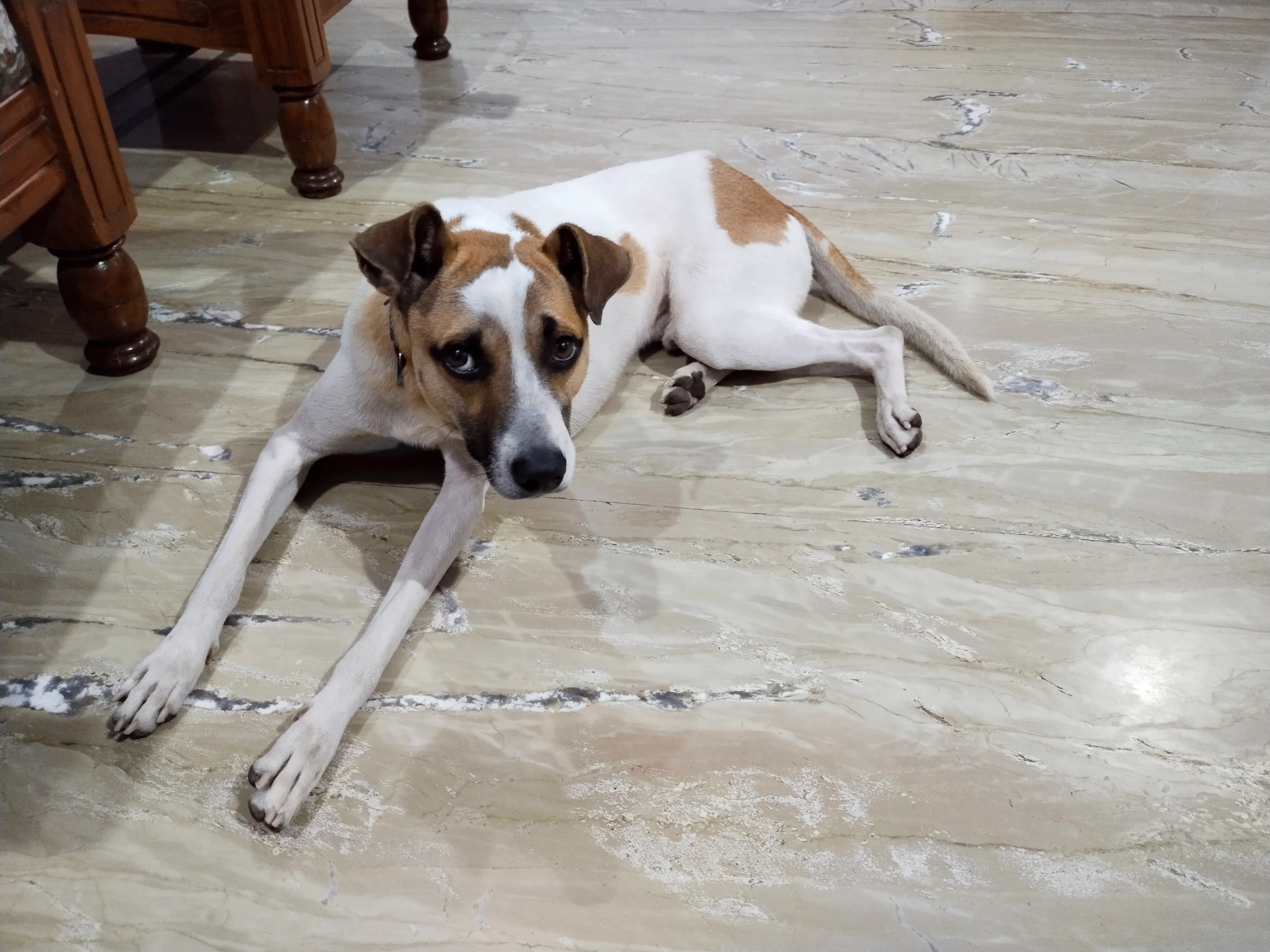
It’s tempting to assume a street-adapted landrace like the INDog wears its own nails down. Some genuinely do, if they’re out on rough pavement daily. But most pet INDogs today live on the same marble and tile as any other city dog, and tile files nothing. Nine in ten apartment dogs in cities like Gurgaon, Mumbai and Bengaluru live on polished floors that give nails no abrasion at all, per Sploot’s nail-cutting guide, and in the monsoon, mud hides overgrowth until you towel the paws dry. If your dog isn’t logging real distance on rough ground most days, the clippers are on you.
The test doesn’t need a calendar: stand your dog on a hard floor. If the nails touch down, or you hear clicking as it walks, it’s time.
Tools: clippers or a grinder
| Tool | Best for | Trade-offs |
|---|---|---|
| Guillotine clippers | Small, thin nails | Fast single cut, but the nail has to sit centred in the hole or it crushes rather than cuts |
| Scissor (plier-style) clippers | Medium to thick nails, most adult INDogs | Handle and blades in line, less twisting; stronger cut for harder nails |
| Nail grinder (Dremel-type) | Dark nails, nervous dogs, rounding edges | Gradual removal shows the colour change before you reach the quick; noise and vibration take some dogs longer to accept |
PetMD recommends scissor-style clippers for thicker adult nails and a grinder specifically for dark nails, though a genuinely jumpy dog may need time with the sound first. Whichever you choose, keep styptic powder within reach before you start.
Step-by-step: trimming with clippers
- Work in good light. This matters more on dark nails than anything else here.
- Hold the paw steady. Thumb on the pad, forefinger on top of the toe; push the thumb up and back while pushing the forefinger forward to extend the nail.
- Angle the blade top to bottom, not side to side, at roughly 45 degrees, following the nail’s natural curve.
- Cut in small slices, about 1–2mm at a time, checking the cross-section after each one.
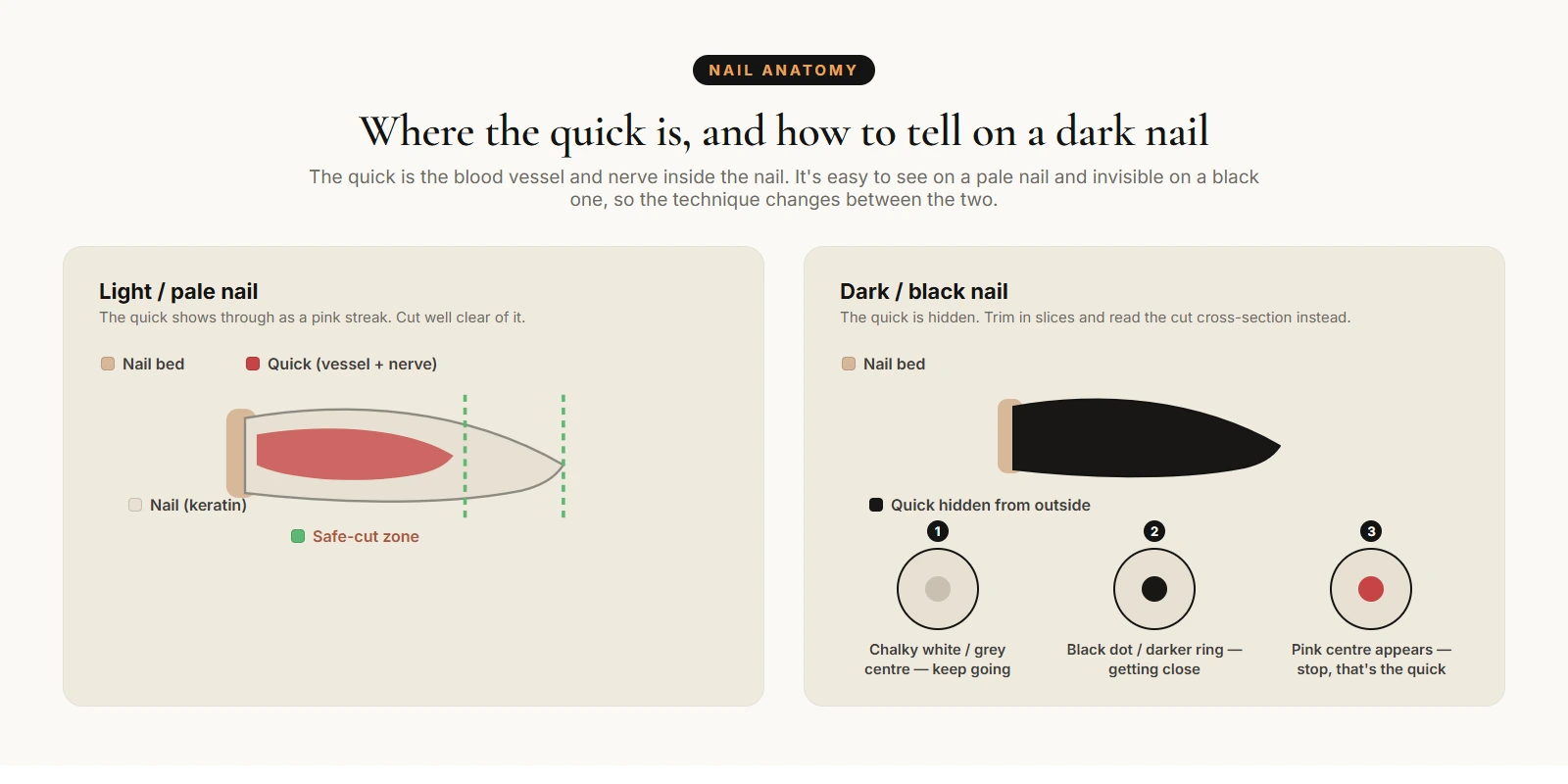
- Watch for the signal to stop. A light nail shows a pink circle (the quick) in the centre. A dark nail shows a chalky white or grey centre when it’s safe, and a black dot or darker ring when the quick is close. Stop there.
- Don’t skip the dewclaws. They never touch the ground, so they never wear down, and they’re easy to forget until they’ve curled.
- File the edge, especially after clippers rather than a grinder.
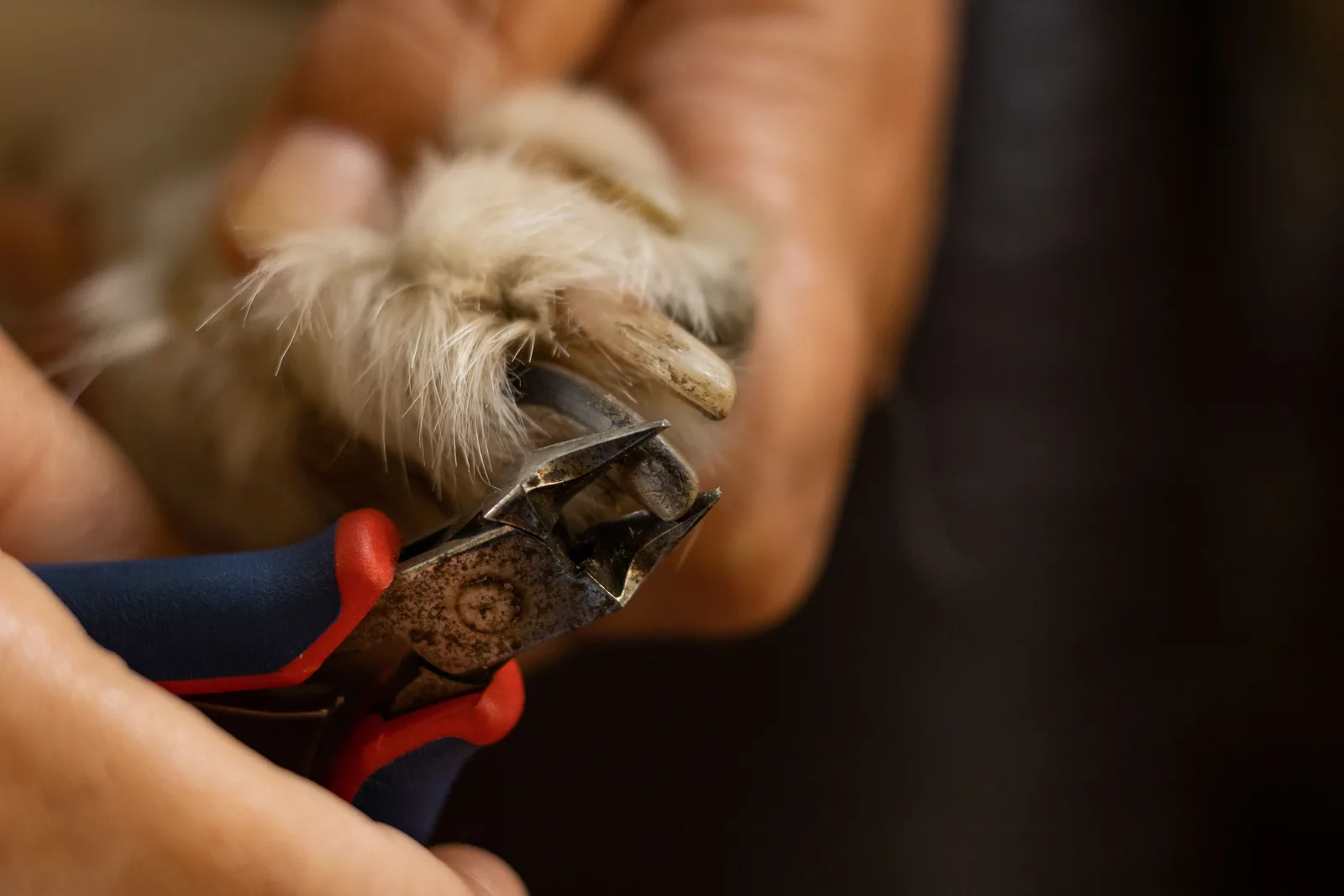
VCA describes aiming the final cut for where the nail starts to curve downward: a slightly generous 2–3mm margin on light nails, only the very tip per pass on dark ones.
Finding the quick on dark nails
Most INDogs have at least some black nails, which is the part that makes people nervous. The quick (the blood vessel and nerve inside the nail) shows up as a pink streak on a pale nail. On a black nail it’s invisible until you’re almost on it.
So don’t look for the quick directly, read the cross-section as you go. PetMD describes watching for “a black dot in the center of the nail”: once it appears, you’ve reached the quick. A bright flashlight or phone torch held behind the nail can also throw it into silhouette as a darker shadow.
There’s a real payoff to trimming little and often: the quick itself recedes over time, letting you eventually keep the whole nail shorter. A commercial grooming source frames this as pure consistency, small weekly trims until the quick backs off (Scenthound), and the underlying mechanism matches what AKC and PetMD describe: the quick grows to fill whatever nail length is available, and shrinks when that length is removed. A dog whose nails have been neglected for months will have a longer quick than one trimmed every few weeks, which is why catching up should happen gradually, not in one sitting.
If you cut the quick
It happens to almost everyone who trims their own dog’s nails eventually. It looks worse than it is: a few drops from a tiny vessel go a long way on a white towel.
Stay calm first; your dog reads your reaction before it registers the pain. Press a clean cloth against the nail with firm, steady pressure. If you have styptic powder, pack a pinch onto the cut end and hold pressure for a minute or two; its active ingredient (commonly ferric subsulfate) helps clot the blood. Vet Dr. Julie Buzby, whose clinic sells a styptic powder brand, recommends this packing-and-pressure method and lists cornstarch, flour or baking soda as substitutes in a pinch (ToeGrips). It’s a commercial source, but its home-remedy advice matches veterinary hospital pages too.
Most minor bleeds stop within 5 to 10 minutes of firm pressure, per VCA’s first-aid guidance. Sources vary slightly on when to call a vet instead of waiting: VCA’s general figure for paw wounds is 10 to 15 minutes, Dr. Buzby’s for a nail specifically is closer to 10. Treat that as a loose range: call your vet if bleeding continues past 10 to 15 minutes, or your dog seems genuinely pained rather than just startled.
Getting a nervous or first-time dog used to trims
A dog that’s never had its paws handled, or had a bad trim before, isn’t being difficult for its own sake. Paws are sensitive, and a dog that’s learned clippers mean pain or restraint will try to avoid both next time.
VCA’s guide flags one common mistake directly: distracting a dog with a treat, then trimming while it’s not paying attention. It feels like a shortcut, but VCA warns it “will damage the dog’s trust in being touched and groomed and often worsens fear rather than decreasing it.” The slower, more durable fix is cooperative care: the dog learns to accept handling because each step is honestly paired with something good, not because it’s been tricked.
- Touch the shoulder or leg, treat, repeat until it gets a relaxed response, not just tolerance.
- Work down to the paw over several short sessions.
- Introduce the clipper without using it: let the dog sniff it, treat, put it away.
- Touch the clipper to a nail without cutting, then build slowly to one real trim.
- Stop at the first stress signal: paw pulled away, lip-licking, yawning, a tucked tail.
Trainer Kayla Fratt, CDBC, favours grinders once clippers have become a trigger: no single “cut” moment to brace for, and “virtually no chance of me cutting their quick” (Journey Dog Training). She also suggests a lick mat stuck to a wall to keep a dog occupied hands-free during the session, a genuine aid, not a distraction trick.
This can take weeks for a dog with real fear, and that’s fine; one calm nail today and two next week is real progress. For a dog that shakes, drools heavily, growls or snaps at the sight of clippers, see a vet before more DIY attempts. Some clinics offer light sedation for the trim itself.
Alternatives to clipping at home
Natural wear works only under real conditions: meaningful daily distance on concrete, asphalt or other hard, abrasive ground. A short walk on grass plus a day on tile or carpet isn’t enough, regardless of breed.
Scratch boards, textured boards a dog paws or digs at, help wear down the front nails between trims.
A professional groomer or vet is a solid choice for dark nails, a fearful dog, or an owner still building confidence. Nail trims in India run cheaper than a full groom, often free or a small add-on at a groomer, with a full session including nail care running roughly ₹600 to ₹2,500 depending on city and tier, per Sploot and The Pet Nest. Watching a professional do it a few times is a reasonable way to build the confidence to take it over at home.
Recommended tools
A few things worth having on hand before your first trim:
- Scissor-style dog nail clippers — the best all-round choice for most adult INDogs.
- Guillotine-style dog nail clippers — an option for a smaller dog or thinner nails.
- Dog nail grinder — useful for dark nails and for dogs that find clippers stressful.
- Styptic powder for dogs — keep this out before you start, not after you need it.
- Dog nail scratch board — helps wear the front nails down between trims.
- Lick mat for dogs — keeps a nervous dog occupied hands-free during a session.
These are plain Amazon search links, not product recommendations for a specific brand or listing, and carry no affiliate tag.
Common questions
How often should I trim my INDog’s nails?
Roughly every three to four weeks, less often for dogs walked daily on concrete, more often for puppies or less active dogs. Simplest check: if nails touch the floor when standing, or click on hard flooring, it’s time. See How often an INDog actually needs a trim.
How do I find the quick on my dog’s black nails?
You can’t see it directly, so trim in small slices and check the cross-section after each one. Chalky white or grey means keep going; a black dot or darkening ring means stop. A bright light held behind the nail can also reveal it as a shadow. See Finding the quick on dark nails.
What do I do if I cut my dog’s nail too short and it’s bleeding?
Stay calm, press a clean cloth firmly against the nail, and pack on styptic powder (or cornstarch or flour) for a minute or two. Most minor bleeds stop within 5 to 10 minutes. Call your vet if it’s still bleeding after about 10 to 15 minutes, or your dog seems genuinely pained. See If you cut the quick.
My dog won’t let me near its paws. What now?
Don’t distract it with treats to sneak in a trim; that tends to backfire. Build up gradually instead: leg, then paw, then clipper without cutting, then one nail, over days or weeks. A grinder can help, since there’s no single “cut” moment. For a dog already snapping or shaking badly, ask your vet about options, including light sedation. See Getting a nervous or first-time dog used to trims.
Do street-adapted dogs like INDogs still need their nails trimmed?
Usually yes. Natural wear needs real daily distance on hard, abrasive ground, and most pet INDogs today live mostly on tile or carpet, which files nothing. See How often an INDog actually needs a trim.
Should I use clippers or a grinder?
Either works. Scissor-style clippers suit thicker adult nails better than guillotine-style, which fit small, thin nails. A grinder removes nail gradually, which makes dark nails easier to judge and suits dogs stressed by a clipper’s snap, though the noise takes some dogs time to accept. See Tools: clippers or a grinder.
Reminder. This article is general information, not veterinary advice. Your dog’s ideal nail-care routine depends on its age, health, nail colour, temperament and activity level. Confirm your approach with a licensed veterinarian or professional groomer if you’re unsure, and seek veterinary care if bleeding from a nail doesn’t stop within about 15 minutes, if a nail is torn or split at the base, or if you see swelling, limping or discharge.
Sources
- How to Trim Your Dog’s Nails at Home — American Kennel Club
- How To Trim Dog Nails — PetMD
- How to Trim a Dog’s Nails — VCA Hospitals
- Taking the Stress out of Nail Trimming for Dogs — VCA Hospitals
- First Aid for Bleeding in Dogs — VCA Hospitals
- How to Stop a Dog’s Nail From Bleeding — Dr. Buzby’s ToeGrips
- What Happens If You Skip Pet Nail Trims? — Pet Evolution
- How to Get Your Dog’s Overgrown Nail Quick to Recede — Scenthound
- How to Help Your Dog Not to Hate Nail Trims — Journey Dog Training
- Dog Nail Cutting Guide: Trim Nails Safely at Home — Sploot
- Dog Grooming Cost in India (2026): Complete Price Guide — The Pet Nest
- Close-up Photo of a Dog’s Nail Being Trimmed — Mirko Fabian, Pexels